
The great AI scramble makes governance the next competitive advantage

It’s no secret that the AI companies are now pulling back on AI’s reins, trying to get the horse to stop bolting from the proverbial stable.
Government and business take their partnership to the next level
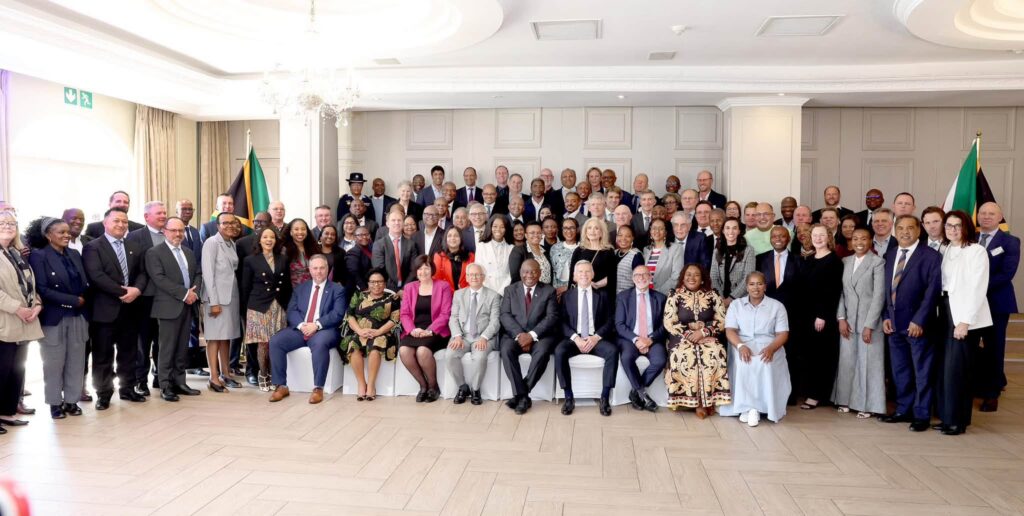
The drive to accelerate structural reforms and interventions has hit third gear as the Government-Business Partnership expands to maximise opportunities to create jobs, inclusive growth and boost investor confidence.
“We need to master statecraft” – Turning promises into progress at the Public Sector Leaders Summit
With unemployment sitting at 33.6% and service delivery dominating headlines as local elections draw closer, what the country is doing for residents at the most basic level was bound to guide much of the discourse.
R2.2-trillion in exports: A look at the oldest customs union in the world

“The world’s oldest customs union has evolved with the times and is a far cry from the 1910 agreement which saw South Africa, the dominant economy, solely responsible for tariff management, and revenue administration and distribution.”
The team sheet is in: Public Sector Leaders Summit 2026 names its strongest line-up yet
Don’t miss the conversations shaping the future of South Africa’s leadership
Navigating cultural fit & strategic headhunting to accelerate female NED Placements

Accelerating female non-executive director (NED) placements in South Africa requires a tactical shift away from traditional executive networks.
The significance of King V

In October 2025, the Institute of Directors in SA launched the fifth iteration of the King Codes of Good Governance. King V is a voluntary, principles-based guidance on corporate governance, not formal law. So what is its significance for corporate SA?
How we can get digital transformation right in the public sector

By Prof. Linda Meyer, MD at Rosebank College When a government digital project fails, the post-mortem rarely points to the software. It points to the people — or more precisely, to the absence of decisive, visionary leadership at the helm. Across the public sector, from municipal councils to national agencies, a pattern has emerged: organisations that successfully harness technology to better serve citizens aren’t necessarily those with the largest budgets or the most sophisticated tools. They are the ones led by individuals who understand that digital transformation is, at its core, a human endeavour. The leadership imperative It has become fashionable to frame digital transformation as a technology problem. Procurement cycles are scrutinised, platforms are debated, and vendors are evaluated with painstaking rigour. Yet the uncomfortable truth is that most public sector digital initiatives don’t stall because of the wrong software, they stall because of the wrong leadership posture. Effective public sector leaders in the digital age are not administrators who happen to oversee technology budgets. They are strategists who understand how to align technology with public value, ethical accountability, and long-term societal outcomes. They ask not, “what can this system do?” but “what do our citizens actually need, and how does this get us there?” This distinction matters enormously. The public sector operates under constraints that private enterprise rarely faces: political scrutiny, limited budgets, entrenched legacy systems, union agreements, and a mandate to serve everyone — not just the digitally literate. Navigating this terrain requires leaders who are as comfortable in the boardroom as they are in the community hall. Setting a vision that goes beyond efficiency One of the most significant leadership contributions to digital transformation is articulating a compelling, user-centred vision. Too many public sector technology projects are sold internally as efficiency drives, cost-cutting exercises dressed in digital clothing. While efficiency matters, it is rarely sufficient motivation to carry an organisation through the inevitable turbulence of large-scale change. Leaders who succeed in digital transformation frame it differently. They connect technology adoption to a broader mission: faster access to social services, more transparent governance, better health outcomes, safer communities. When staff understand why the change is happening, and can see themselves as participants in something meaningful, resistance softens, and momentum builds. This is not idealism. It is a strategy. Purpose-driven change management is consistently more effective than top-down mandate alone, particularly in public institutions where staff are often mission-motivated rather than incentive-driven. Championing change from the inside out Even the most visionary leader cannot transform an organisation single-handedly. One of the most underrated leadership skills in digital transformation is the ability to identify and cultivate internal champions, the mid-level managers, frontline workers, and IT staff who become advocates for change within their own teams. These champions serve as cultural translators, bridging the gap between strategic ambition and operational reality. They surface the friction points that leaders in senior roles never see, and they carry credibility with colleagues who might be sceptical of directives from above. Smart leaders don’t just appoint champions, they create the conditions for champions to emerge naturally by fostering psychological safety and rewarding experimentation over compliance. Sustaining momentum through bureaucratic headwinds Executive sponsorship is not a formality, it is a lifeline. Digital transformation projects in the public sector face a unique set of institutional pressures: budget cycles that don’t align with technology timelines, ministerial changes that reset priorities overnight, and procurement rules written before cloud computing existed. Leaders who maintain visible, active sponsorship of digital initiatives signal to the organisation and to external partners that this work matters and will not be quietly shelved when things get complicated. Without that signal, projects drift. With it, teams push through. Research from the OECD and the UK’s Government Digital Service consistently shows that the single biggest predictor of digital project success in government is sustained senior leadership commitment. Not the technology stack. Not the vendor. Leadership. Building the capabilities that technology demands Finally, no digital strategy survives contact with a workforce that lacks the skills to execute it. Leaders must make deliberate, often difficult decisions about where to invest not just in platforms and infrastructure, but in people. This means budgeting for digital skills training, recruiting specialist talent, and, critically, creating career pathways that make the public sector competitive with private industry. It also means being honest about what the organisation can build internally and what it needs external expertise to deliver. That judgment call, made well or poorly, can define the outcome of a transformation programme. The bottom line Digital transformation in the public sector will always involve technology. But it will always be decided by leadership — by the clarity of the vision, the courage to champion change, the discipline to sustain momentum, and the wisdom to invest in people as much as platforms. Governments that grasp this will build services their citizens deserve. Those who do not will continue buying technology they cannot use. Prof. Linda Meyer, MD at Rosebank College
Topco Media launches ESG: The Future of Sustainability in time for Environment Month

With the foreword written by Executive Director at the Presidential Climate Commission, Dorah Modise, this important 8th edition of ESG: The Future of Sustainability publication focuses on where we are in terms of the environment, society and governance – locally and globally – where we would like to be, and why we need a “whole of society “ approach to get there. The foreword is followed by an opinion piece by the Deputy Minister of the Department of Forestry, Fisheries and the Environment (DFFE), Honourable Narend Singh. Inside the publication, you’ll find a range of significant contributions from a number of sustainability Thought Leaders, including Dr Morné du Plessis, CEO of WWF; André Nepgen, CEO of Discovery Green;; Kalnisha Singh, Development Economist and Director of KD Strategies; and Devina Naidoo, Senior Policy Advisor: International Sustainable Development and Trade, DFFE. There is an all important selection of articles falling under the three sections of ESG. The Environment pillar explores e-transport; e-waste; micro plastics; sustainable agriculture and sustainable mining; as well as the importance of green buildings. The Social segment asks the all-important question “How do you measure the ‘S’ in ESG?” – and no discussion on the social component would be complete without articles on training and skills development; workplace wellness; and mentorship as well as why people-centred businesses are the most powerful. Governance is the third vital pillar for sustainability and in this section we bring you up to date on the important happenings in South Africa regarding the P20 and G20 Environment and Climate Sustainability Working Group. Since 1994, the King Reports have encouraged organisations to aspire to higher ethical standards than mere compliance to legal requirements. In October 2025, the Institute of Directors launched the fifth iteration of the King Codes of Good Governance – see the article to find out its significance for the country. Having just endured a weather event of such magnitude in the Western and Eastern Cape that it was declared a national disaster, the case for sustainability and mitigation of climate change grows stronger with each passing year. Read the 8th edition of ESG: The Future Of Sustainability here. For more information on the Future Of Sustainability, visit futureofsustainability.co.za or contact our Head of Brand, Twaambo Judy Chileshe at: twaambo.chileshe@topco.co.za
4 days to South Africa’s premier sustainability forum: Engage directly with ministers and industry leaders

The event will feature Deputy Minister of Water and Sanitation, Mbangiseni David Mahlobo, whose extensive experience in public administration, provincial governance, and national policymaking has been instrumental in advancing South Africa’s water security and sanitation strategies.