By Koketso Mamabolo
There are not many institutions that have survived the test of time the way the Southern African Customs Union (SACU) has with its history dating back to colonial times in the late 19th century. As President Cyril Ramaphosa said in his opening remarks at the SACU’s 9th Summit of Heads of State and Government, “SACU has lived through empire, two world wars, the Great Depression, the struggle against colonialism, and apartheid, the birth of independent African states and the transformation of our own region.”
The world’s oldest customs union has evolved with the times and is a far cry from the 1910 agreement which saw South Africa, the dominant economy, solely responsible for tariff management, and revenue administration and distribution.
The 2002 agreement instituted joint decision-making and a common negotiation mechanism between member states and third parties. The members – South Africa, Botswana, Namibia, Lesotho, and the Kingdom of Eswatini – form a single customs territory where goods move freely without tariffs and other barriers.
Imports from third parties are subject to a Common External Tariff (CET) and member states coordinate excise and customs policy. The revenue collected from excise and customs duties is shared among the member states in a system which sees the net importing ‘beln’ countries – Botswana, Eswatini, Lesotho, and Namibia – taking a higher share of the revenue.
In the 2022/23 financial year, trade between the member states increased by 14.9% from the previous year to R271.3-billion. The 2024/25 financial year saw R171.2-billion being distributed among member states, another increase, but geopolitical tensions and a volatile global trade relationships will likely see a drop for 2025/26.
The Summit
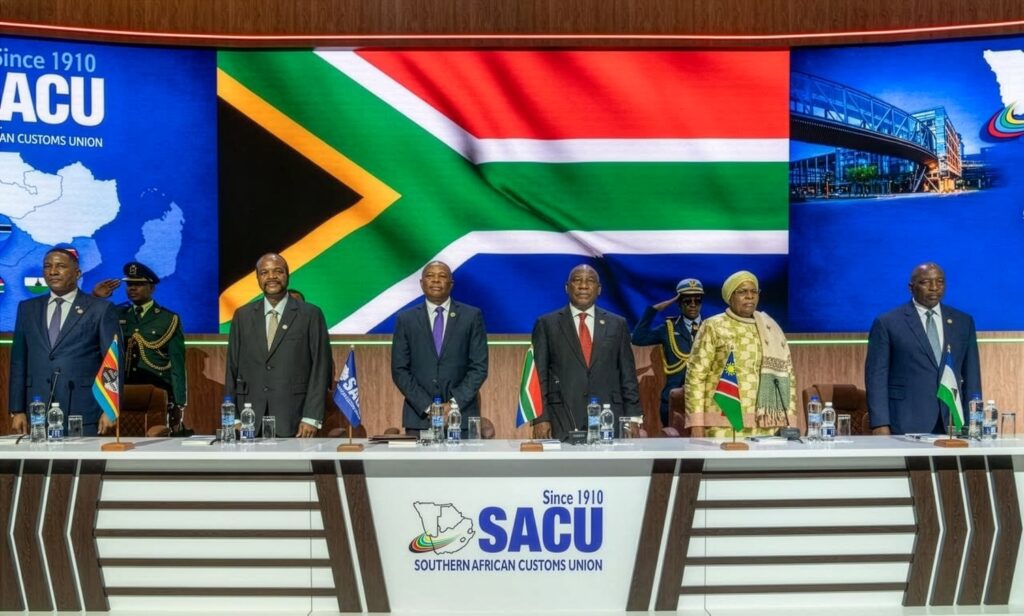
The 9th summit of the SACU’s Heads of State and Government took place in June in Cape Town where officials received an update on the implementation of the 2022 – 2027 strategic plan which sets out five priorities:
- Industrialisation, export and investment promotion
- Trade facilitation and logistics
- Implementation and leveraging of AfCFTA opportunities
- Trade relations/unified engagement with third parties
- Finance and resource mobilisation
While the member states rotate the chairmanship of the SACU, the Council, Commission, and the Secretariat are behind much of the SACU’s work. The Council consists of the member state’s Ministers of Finance, and Trade & Industry, who give policy direction, make decisions, approve revenue shares and set negotiation mandates between the SACU and third parties.
The Commission is responsible for implementing the 2002 agreement and Council decisions, and overseeing the Common Revenue Pool (CRP). It consists of member states’ permanent secretaries, director-generals, and other officials of equivalent rank. The day-to-day operations and record-keeping of CRP transactions is done by the Secretariat, which also assists in negotiations with third parties.
This year’s summit saw member states deliberating over the “the rise of protectionism and unilateralism” saying in its communiqué following the summit that the “economic ramifications of these developments include disruptions in supply chains, elevated energy and food prices, and a subdued global growth outlook.”
But the story is not all bad, as President Cyril Ramaphosa noted in his opening remarks:
“The SACU economies have, however, proved resilient against external shocks, supported by stronger regional integration, the diversification of export destinations and effective risk-mitigation measures. It is through regional integration that our regime will continue to strengthen economic sovereignty.”
This does not mean that the SACU is aware of the importance of solid agreements with the rest of the world, particularly with the US, whose decision to extend AGOA was commended by the SACU which called for a 15-year extension of the programme.
The Summit approved a R5-billion “fund for funds” which will support development projects in the region and acknowledged that industrialisation, export and investment promotion are key to the long-term growth and relevance of the SACU. In the economic climate the SACU finds itself in, what is needed is what President Ramaphosa referred to as a “reimagined” SACU.
“It is time to move away from the traditional role of SACU as a customs arrangement and towards being the premier platform for regional economic resilience and self-reliance,” said President Ramaphosa. “This is essential because institutions ultimately become custodians of the past rather than architects of the future.”
“In the end let history record that this generation of African leaders transformed the world’s oldest customs union into one of its most dynamic engines of regional development.”
Sources: SACU | The Presidency