By Koketso Mamabolo
The drive to accelerate structural reforms and interventions has hit third gear as the Government-Business Partnership expands to maximise opportunities to create jobs, inclusive growth and boost investor confidence.
“What started as a platform to address multiple crises has evolved into a platform for growth and shared prosperity,” said President Ramaphosa in a joint statement following the launch of Phase 3 of the partnership.
“This partnership has endured because our ambition for South Africa is strongly aligned. We both seek an economy that is growing, an economy that is creating jobs, and an economy that includes those who have been left outside for too long.”
Adrian Gore, the chairperson of BLSA and co-convenor of the partnership said that the country has world-class capabilities with natural advantages and sectors with untapped potential.
“Phase 3 has been meticulously designed to unlock potential through targeted interventions in areas where South Africans can compete globally and win.”
Building on success
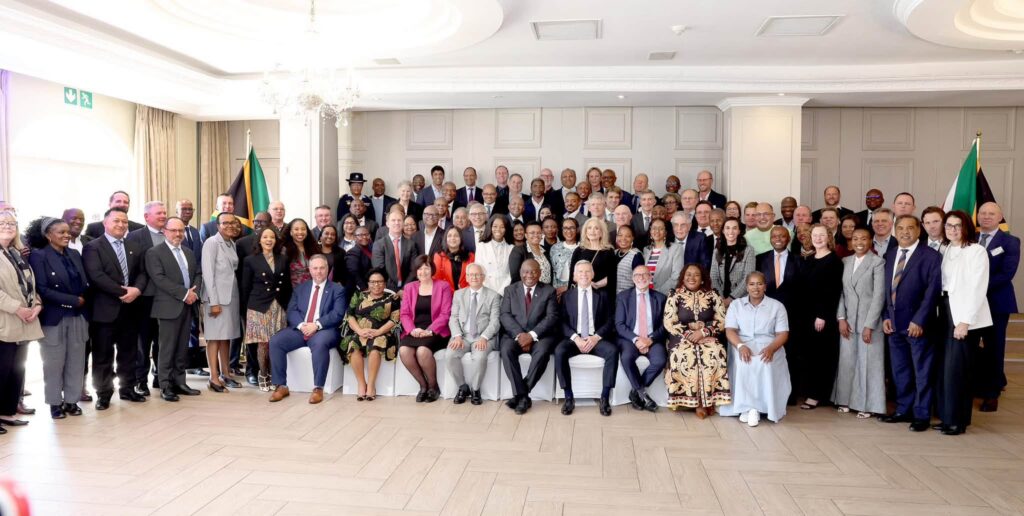
Led by the President along with senior cabinet ministers, one of the defining features of the partnership is the involvement of over 160 CEOs from some of the country’s leading companies who have been providing resources, funding, expertise and helping bridge capacity gaps.
There has already been progress in the four focus areas: energy, transport & logistics, crime & punishment, and youth unemployment.
In terms of crime & punishment, South Africa was recently removed from the Financial Action Task Force’s greylist. In the energy sector we have seen the end of loadshedding after a peak of a staggering 335 days in 2023.
In transport & logistics three of the country’s ports were listed in the top six most improved in the world, with Durban’s port coming in at the number one. The Durban Gateway Terminal partnership has unlocked R10.5-billion, and around R500-billion is in the investment pipeline for PSP transactions.
The third phase is designed to convert that momentum into accelerated growth and job creation, which is becoming more of an urgent crisis with the latest unemployment figure sitting at 33.6% with little signs of improvement given the external pressures from the geopolitical climate.
The 3% annual GDP growth rate is still the target, although it is not yet clear how this will be achieved given failures to do so in the past. The second quarter of 2026 has already seen a 0.2% quarter-on-quarter decline.
“We need to move beyond business as usual and lift growth above 3% if we are to start to create net jobs,” continued Adrian. All the initiatives in Phase 3 will be measured against the growth target and the creation of one million jobs by 2030. Business is fully committed to contributing leadership, expertise, implementation capacity and investment support alongside government.
“We believe South Africa has a significant opportunity to build a self-reinforcing cycle of an improved narrative, investment, growth, jobs and increased confidence. The inclusion of many additional CEOs to lead our work bears testimony to our approach.”
Some of the Phase 3 targets
- 550km – The total length of transmission lines to built by March 2027
- 6 – The number of private train operating companies operating by 2027
- 1.8-million – The number of work opportunities by 2030
- R50-billion – The amount capital expenditure in mining to be unlocked by February 2030
- R5-billion – The export value to be recovered by the 2026/27 summer season
- 8.1 million- The number of visitor arrivals by land and sea by December 2027
- 3.8 million – The number of visitor arrivals by air by December 2027
The approach rests on three pillars, with youth employment cutting across all three. The first focuses on the enablers of growth, namely energy, transport & logistics. The second pillar is about new growth drivers: mining, tourism, infrastructure, and agriculture & agri-processing. The country is seen as having a competitive advantage in these sectors which can be leveraged.
The third and final pillar focuses on the confidence multipliers i.e. the things that affect investor sentiment: the efficacy of the criminal justice system, local government challenges, and the building of an “evidence-based national growth narrative.”
The new sectors are not the only way the model is being scaled up. There are now more cabinet ministers involved and more CEO sponsors, with the promise of quarterly report backs and detailed metrics.
“This partnership does not transfer the responsibilities of government to business,” said the President at the Phase 3 launch. “It does not blur the distinction between public authority and private interest. Rather, it brings together the respective capabilities of government and business in pursuit of clearly defined national objectives.
“It recognises that the state must govern, regulate and deliver. It recognises that business must invest, innovate, produce and create employment. And it recognises that both government and business have a shared responsibility to build a more inclusive economy and a more equal society.”
Sources: The Presidency | Business 4 SA | Minerals Council SA